
Today is International White Cane Day, and the Kenya Society for the Blind (KSB) is marking it with new canes in hand. On Wednesday, 14 October, assistive technology hub Senses Hub donated Ambutech white canes worth KES 200,000 to KSB in Nairobi. Senses Hub CEO Caroline Kamaitha presented the first cane.
The donation comes in a milestone year for KSB, which was established in 1956 and is celebrating its 70th anniversary.
"They have come to recognise our work"
Samson Waweru, Executive Director of KSB (pictured top), said the canes were a fitting gift for the anniversary.
"We are really honoured and happy to receive these gifts at our 70th anniversary: quality white canes, of a special type made in Canada and the USA. They have come to recognise our work, and I am really impressed."
Waweru said the handover was the start of a wider partnership. "We have discussed many things in our partnership that will be coming up," he said. These include joint advocacy for quality, affordable assistive devices for people who are blind or visually impaired. He also appealed to corporates and the government to join that effort.
KSB, he said, looks forward to serving people "with the highest level of empathy and dignity."
"Not a transaction, but a relationship"
Kamaitha described Senses Hub as a go-between for people and the tools they need.
"It is a privilege to be here today," she said. "We are the partner in the middle, between the need and the technology. We bring in assistive devices, or use assistive technology to build solutions, that address the needs of people who are visually impaired, blind or living with a different type of disability."
The idea, she said, is a reliable cane that gives the user freedom of mobility, with dignity and independence.
She was clear that the donation is not a one-off. "We are trying to move away from a transaction to a relationship," she said. "If we give you a cane, we make sure that whatever you need afterwards, whether it is a replacement of the tips or any modular repairs, is taken care of."
More than a stick
A white cane is a mobility and identification tool. People who are blind or have low vision use it to explore their surroundings, find obstacles in their path and let others know they have vision loss.
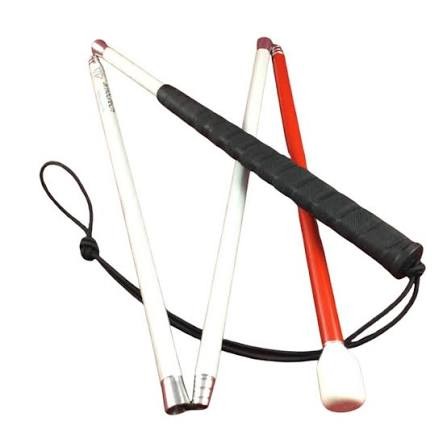
The canes in this donation are made by Ambutech. The cane pictured below is a folding model, which collapses into sections so it can be carried in a bag when not in use.
Why it matters on White Cane Day
International White Cane Day falls on 15 October each year, a week after World Sight Day. It recognises the white cane as a symbol of independence for people who are blind or visually impaired, and reminds everyone else that they have a part to play too.
In Senses Hub's statement on the donation, Kamaitha put it this way:
"Every person with visual impairment deserves the opportunity to move safely, access education, pursue their ambitions and participate fully in society. At Senses Hub, we believe that access to assistive technology is not a privilege; it is a pathway to equal opportunity."
"Together," she added, "we must build a Kenya where every white cane is met with respect, accessible environments and a commitment to inclusion."
That last point matters as much as the canes themselves. A cane works best in a city with clear pavements, accessible public spaces and people who know what it means when they see one.
KSB's 70 years of work reach well beyond equipment. Earlier this week, the society's Gusa Nafsi Band led the national anthems at the launch of the Inclusive Education Hub for Africa in Nairobi.
This report draws on remarks at the handover and Senses Hub's press release of 14 October 2026. For more information, contact Senses Hub at [email protected] or +254 757 170 802.
Leave a comment